Where to Stay While Lāhainā Rebuilds: Kīhei Guide
Travelers who had planned to stay in Lāhainā town can consider accommodations elsewhere in West Maui, including Kāʻanapali, Honokōwai, Kahana, Nāpili, and Kapalua, or in the South Maui communities of Kīhei and Wailea. These West Maui areas are open and welcoming guests. Travel from South Maui to Lāhainā generally takes about 45 minutes or longer, depending on traffic and road conditions.
Visitor accommodations within Lāhainā town remain very limited as the community continues its long-term recovery and rebuilding following the August 2023 wildfire. For travelers who choose South Maui, The Hale Pau Hana offers oceanfront condominium accommodations directly on Kamaʻole Beach Park II, with a full kitchen in every unit and West Maui accessible for a thoughtfully planned day trip.
Key takeaways
- Visitor accommodations within Lāhainā town remain very limited as the community continues its long-term recovery and rebuilding following the August 2023 wildfire.
- Farther north, the resort communities of Kāʻanapali, Honokōwai, Kahana, Nāpili, and Kapalua are open and accepting guests.
- As of August 2026, Maui County has reopened Front Street to vehicle traffic between Papalaua and Shaw streets, while Market Street, Papelekane Street, and Mokuhinia Place remain closed for ongoing work; confirm current access before you travel.
- Visitors are asked to respect all posted closures, barriers, and fence lines, to stay off private property and outside restricted areas, and to avoid photographing fire-affected homes, properties, and recovery areas.
- Kīhei, in South Maui, is about 45 minutes or more from Lāhainā town by road depending on traffic, with condominium lodging, full kitchens, and seven named public beaches.
- The Hale Pau Hana, an oceanfront condominium property at 2480 South Kīhei Road, Kīhei, HI 96753, fronts Kamaʻole Beach Park II directly, and West Maui is accessible for a thoughtfully planned day trip.
What lodging is currently available in Lāhainā town?
On August 8, 2023, a wind-driven wildfire devastated much of historic Lāhainā, including the Front Street commercial district and surrounding residential neighborhoods. The disaster claimed lives, displaced families, and destroyed homes, businesses, and treasured cultural landmarks. Once the capital of the Hawaiian Kingdom and part of a National Historic Landmark District, Lāhainā remains a place of deep cultural, historical, and personal importance. Its residents continue the long process of recovery and rebuilding.
Most of the hotels, small inns, and vacation rentals previously located within Lāhainā town are no longer operating, so visitor accommodations in the town itself remain very limited. Farther north, the resort communities of Kāʻanapali, Honokōwai, Kahana, Nāpili, and Kapalua are open and accepting guests, although the effects of the disaster continue to be felt throughout West Maui.
Visitor accommodations in Kīhei and Wailea were not physically damaged by the Lāhainā wildfire. However, it would not be accurate to describe South Maui as unaffected, since the disaster created economic, housing, workforce, and emotional impacts throughout the island.
Where you stay will depend on your itinerary, preferred accommodations, and the areas you plan to explore. Visitors can support West Maui by patronizing businesses that are open, following current access guidance, respecting restricted areas and residents’ privacy, and contributing to established community organizations if they wish to do more.
What is open in Lāhainā and West Maui in 2026?
This is the fastest-changing information on this page, so treat the table below as a snapshot taken in early August 2026 and confirm current status before you travel.
Maui County reopened Front Street to vehicle traffic between Papalaua and Shaw streets on August 1, 2026, along with Dickenson and Prison streets. The county has said rebuilding continues throughout the commercial district and that temporary closures may still occur.
| Place | Status as of August 2026 | What to know |
|---|---|---|
| Front Street, Papalaua to Shaw | Reopened to vehicle traffic on August 1, 2026 | No regularly restricted hours; Dickenson and Prison streets reopened at the same time |
| Market Street, Papelekane Street, Mokuhinia Place | Closed | Ongoing work, including state dredging at Lāhainā Harbor |
| Ulu o Lele Marketplace, former Outlets of Maui site | Announced to open in fall 2026 | A nonprofit-led project of small retail units and food truck spaces on Front Street; confirm the opening date before you plan around it |
| Lāhainā Harbor | Phased reopening since December 2025, limited commercial tours | Daytime departures only while harbor power is restored; book ahead and confirm your departure point with the operator |
| Banyan Tree Park | Closed to the public as of August 2026 | The tree survived the fire and is under long-term arborist care; designated viewing areas sit at the edge of the park and county officials have said access may resume later in 2026 |
| Lahaina Cannery Mall, north Lāhainā | Open | Grocery, pharmacy, shops, and restaurants; a practical stop on a day trip |
| Kāʻanapali resort area | Open | Resorts along Kāʻanapali Beach plus Whalers Village |
| Honokōwai, Kahana, Nāpili | Open | Condominium buildings, small shops, and local restaurants |
| Kapalua | Open | Resorts, golf, Kapalua Bay, and the northwest coast beyond it |
Named restaurants and shops have been reopening steadily across West Maui, some in their original buildings and some in new locations. Because individual businesses move and change hours, check a current listing or call ahead the week of your trip.
Visiting Lāhainā with care
Lāhainā remains home to families and businesses navigating a long-term recovery. Visitors are encouraged to approach the community with patience, awareness, and respect.
Ways to support local communities
- When planning ocean activities, consider booking with West Maui operators. Snorkeling and seasonal whale-watching excursions depart from Lāhainā Harbor during its phased daytime reopening, while other operators launch directly from Kāʻanapali Beach.
- Support businesses that are open in Lāhainā, Kāʻanapali, Honokōwai, Kahana, Nāpili, and Kapalua. Dining locally, shopping with small businesses, and booking activities with area operators are practical ways visitors can contribute to West Maui's economic recovery.
- If it fits your itinerary and budget, consider dividing your vacation between South Maui and West Maui. This provides time to experience both areas while supporting accommodations and businesses in each community.
- Travelers wishing to provide additional support may donate directly to established Maui organizations involved in community recovery. Verify organizations through trusted local or government resources before contributing.
How to visit respectfully
- Please do not enter closed neighborhoods or photograph or film fire-affected homes, properties, or recovery areas. Drone use over restricted areas is also prohibited.
- Respect all posted closures, barriers, and fence lines. Maui County asks visitors to remain off private property and outside restricted areas to protect public safety and the privacy of families rebuilding.
- Please avoid asking residents or service workers to share their personal experiences of the disaster.
- Avoid before-and-after social media posts that focus on the community's loss. Instead, share Maui's natural beauty, your experiences, and the local businesses you support during your visit.
Where can you stay closest to Lāhainā?
If proximity to Lāhainā matters to your trip, West Maui is the answer, and the closest open lodging sits just a few miles up the coast. Distances below are approximate and measured from the center of Lāhainā town.
| West Maui area | Approx. distance from Lāhainā town | What it is like |
|---|---|---|
| Kāʻanapali | About 3 to 4 miles north, 10 to 15 minutes | Master-planned resort area on a long sand beach, with large resorts, Whalers Village, and Black Rock at the north end |
| Honokōwai and Kahana | About 6 to 8 miles north, 15 to 20 minutes | Older condominium buildings at generally lower rates, with small shops and local restaurants |
| Nāpili | About 8 to 9 miles north, 20 minutes | A small crescent bay ringed by low-rise condominiums, quieter than Kāʻanapali |
| Kapalua | About 10 miles north, 20 to 25 minutes | Two large resorts, championship golf, Kapalua Bay, and access to the northwest coast |
For a direct look at a Kāʻanapali resort stay beside a Kīhei condominium stay, see Kīhei vs Kāʻanapali. For the wider regional picture, including weather, drive times, and what each coast is good at, see South Maui vs West Maui.
How far is Kīhei from Lāhainā and West Maui?
Kīhei sits on Maui's leeward south shore, southeast of Lāhainā across the island's central isthmus and around the base of the West Maui Mountains. One road connects them. Honoapiʻilani Highway, Route 30, runs from Māʻalaea along the pali and the shoreline past Olowalu and Launiupoko into the Lāhainā area, and the Lāhainā Bypass, Route 3000, carries through traffic around the town toward Kāʻanapali.
From The Hale Pau Hana at 2480 South Kīhei Road, plan on about 45 minutes or more to Lāhainā town, 45 to 55 minutes to Kāʻanapali, and 55 to 70 minutes to Kapalua. Because Route 30 is the only practical way in and out of West Maui, afternoon backups, road work, and occasional high surf closures along the coastal stretch can add time. Check the Hawaii Department of Transportation Maui lane closure page before a day trip.
| From The Hale Pau Hana to | Approx. distance | Typical drive |
|---|---|---|
| Māʻalaea Harbor | About 11 miles | About 15 minutes |
| Olowalu | About 19 miles | About 30 minutes |
| Lāhainā town | About 25 miles | About 45 minutes or more |
| Kāʻanapali and Whalers Village | About 29 miles | 45 to 55 minutes |
| Kapalua | About 35 miles | 55 to 70 minutes |
What does a West Maui day trip from Kīhei look like?
Treat it as a full day, not an errand. Leave Kīhei by about 7:30am and you get the coastal drive in cool light with the mountains on your right and, between late November and early May, humpback whales working the water on your left. Māʻalaea Harbor comes up about 15 minutes north of Kīhei and is worth a stop for the Maui Ocean Center or a boat departure of its own.
A workable shape for the day: arrive in West Maui mid-morning for a snorkel or whale watch departure from Lāhainā Harbor or Kāʻanapali Beach, have lunch at an open West Maui restaurant, spend the afternoon on Kāʻanapali Beach or at Kapalua Bay, walk Whalers Village or Lahaina Cannery Mall, then eat dinner in West Maui before driving back. The return leg runs about the same hour, and the road is dark and winding in places, so take it slowly.
If you want an evening in West Maui, luau and dinner shows in the Lāhainā and Kāʻanapali area book out well in advance and typically end late enough that the drive home lands close to 10pm. For options closer to your condominium, see luaus near Kīhei. If your interest is whales or Molokini specifically, South Maui has its own departures: see whale watching from Kīhei and Molokini tours from Kīhei.
What does Kīhei offer as a base?
Kīhei is a six-mile beach town on the dry, sunny side of Maui, in Haleakalā's rain shadow. It gets roughly 10 to 13 inches of rain a year and 300 or more sunny days, which makes it one of the driest towns in Hawaii and a reliable place to plan beach days. Seven named public beaches line the town, and Maui County lifeguards are on duty daily from 8am to 6:45pm in summer and 7:30am to 6:15pm in winter at the three Kamaʻole beach parks. Every beach in Hawaii is public by law.
Lodging in Kīhei is mostly individually owned condominiums with full kitchens, lanais, and laundry facilities, which changes the math on a longer trip. Two full-size grocery stores sit within a few minutes by car. Kahului Airport is about 16 miles away, about a 25-minute drive, and Kīhei is well placed for Haleakalā sunrise, the Road to Hāna, and Molokini. The Kīhei guide covers the town in full.
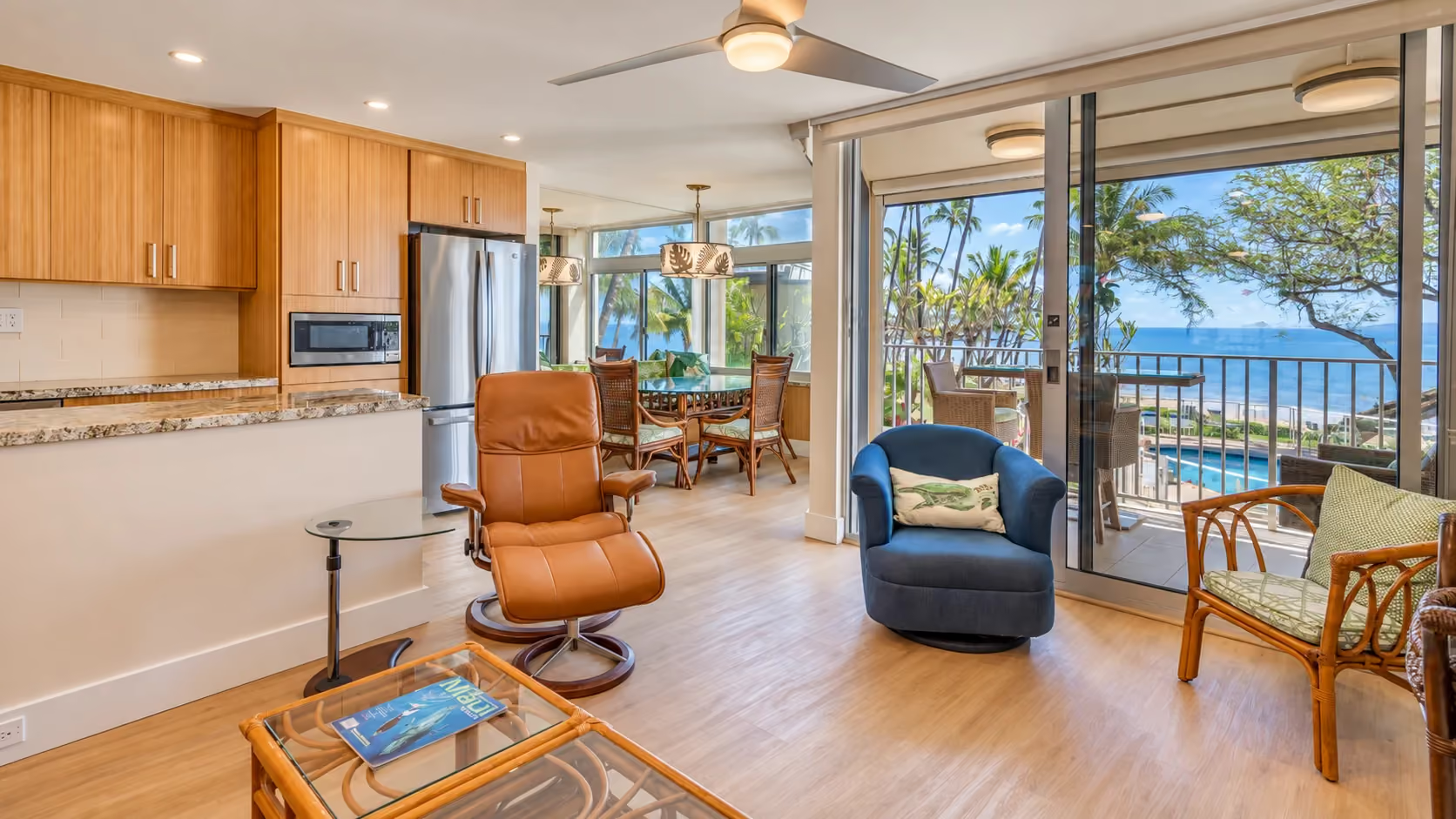
The Hale Pau Hana is one of the properties on that stretch of coast. It is an oceanfront condominium property at 2480 South Kīhei Road, operating since 1970, with 68 individually owned units across four buildings on two acres. Every unit is oceanfront with a private ocean-facing lanai, and the two-acre lawn ends at the sand of Kamaʻole Beach Park II, so there is no road to cross. Every unit has a full kitchen, parking is free with one stall per unit, and there are no resort fees. Complimentary coffee is served on the oceanfront lawn Monday to Saturday, 8am to 10am.
Should you base in West Maui or South Maui?
Both work, and a lot of travelers split the trip between them, which spreads spending across two communities.
Who should base in West Maui?
- Travelers who want to be close to Lāhainā and put their lodging spend directly into the West Maui economy.
- Anyone who wants a full-service resort on Kāʻanapali Beach, with a spa, kids' programming, and daily housekeeping.
- Snorkelers and divers focused on Honolua Bay, Kapalua Bay, and the northwest coast.
- Guests tied to West Maui by a wedding, a conference, or friends already staying there.
Who should base in South Maui?
- Travelers who want a condominium with a kitchen and a lower nightly rate than a comparable resort room.
- Families who value lifeguarded, sand-bottom swimming at the Kamaʻole beach parks.
- Anyone building an itinerary around Haleakalā, the Road to Hāna, Molokini, or Wailea, all of which are shorter drives from Kīhei.
- Visitors planning one or two West Maui days inside a wider island trip.
Whichever you choose, the West Maui day trip is easy to build into the week, and the businesses there would rather see you for a day than not at all. See South Maui for how Kīhei, Wailea, and Mākena fit together.
Frequently asked questions
Where to Stay While Lāhainā Rebuilds?
Visitor accommodations within Lāhainā town remain very limited, so the two usual choices are West Maui just north of it or South Maui. Kāʻanapali, Honokōwai, Kahana, Nāpili, and Kapalua are open and are the closest places to stay to Lāhainā. Kīhei and Wailea, in South Maui, are about 45 minutes or more from Lāhainā town by car depending on traffic, and offer condominiums with kitchens and public beaches with lifeguards on duty.
Is Lāhainā open to visitors in 2026?
Parts of it. Maui County reopened Front Street to vehicle traffic between Papalaua and Shaw streets on August 1, 2026, and Dickenson and Prison streets reopened at the same time. Market Street, Papelekane Street, and Mokuhinia Place remained closed for ongoing work. Lahaina Cannery Mall in north Lāhainā is open, and Lāhainā Harbor has run limited commercial tours since a phased reopening in December 2025. Confirm current access before you go.
What is the respectful way to visit Lāhainā?
Please do not enter closed neighborhoods or photograph or film fire-affected homes, properties, or recovery areas. Drone use over restricted areas is also prohibited. Respect all posted closures, barriers, and fence lines. Maui County asks visitors to remain off private property and outside restricted areas to protect public safety and the privacy of families rebuilding. Please avoid asking residents or service workers to share their personal experiences of the disaster. Avoid before-and-after social media posts that focus on the community's loss.
Should visitors still come to Maui?
Yes. Maui's visitor economy supports a large share of local jobs, and tourism officials and West Maui business owners have consistently asked travelers to come and spend thoughtfully. The most useful thing a visitor can do is book West Maui restaurants, shops, and tour operators that are open, whether you are staying in Kāʻanapali, Kapalua, Kīhei, or anywhere else on the island.
How far is Kīhei from Lāhainā?
About 25 miles by road and about 45 minutes or more of driving, north from Kīhei to Honoapiʻilani Highway and then around the coast. Kāʻanapali runs about 45 to 55 minutes from Kīhei and Kapalua closer to an hour or more. Honoapiʻilani Highway is the only practical route in and out of West Maui, so allow extra time for traffic, road work, and occasional coastal closures.
Are the Kāʻanapali and Kapalua resorts open?
Yes. The Kāʻanapali and Kapalua resort areas were not affected by the 2023 wildfire and are operating, along with the condominium neighborhoods at Honokōwai, Kahana, and Nāpili. Whalers Village at Kāʻanapali is open, as are Kāʻanapali Beach and both Kāʻanapali golf courses; the Kapalua Bay course remains closed. Individual properties change their offerings and renovation schedules, so confirm details directly with a property when you book.
Can you take a boat tour from Lāhainā Harbor?
On a limited basis. Lāhainā Harbor began a phased reopening in December 2025, and a small number of commercial operators have been running daytime snorkel and whale watch trips from it while state dredging work continues nearby. Sunset and evening departures have not resumed while harbor power is restored, so book a daytime trip and confirm your departure time. Boats also leave from Kāʻanapali Beach and, on the South Maui side, from Māʻalaea Harbor about 15 minutes north of Kīhei.
Can you see the Lāhainā banyan tree?
Banyan Tree Park was still closed to the public as of August 2026 while the tree recovers under long-term arborist care, so you cannot walk beneath it. The tree survived the fire and has put out new growth, and you can see it from designated viewing areas at the edge of the park. County officials have said access may resume later in 2026, so check current status first.
Looking for a South Maui base with West Maui in day trip range?
The Hale Pau Hana is an oceanfront condominium property on Kamaʻole Beach Park II in Kīhei, with Lāhainā and Kāʻanapali about an hour up the coast. Check availability
Check availability →