Work From Maui: Where to Stay in Kīhei for Remote Work
Hawaii runs two to three hours behind the US west coast and does not observe daylight saving, so mainland mornings land early here and most remote workers are finished by early afternoon. What decides a good workation is a real table, Wi-Fi you confirmed before booking, and a lanai for calls. Here is how to set up a working month in Kīhei.
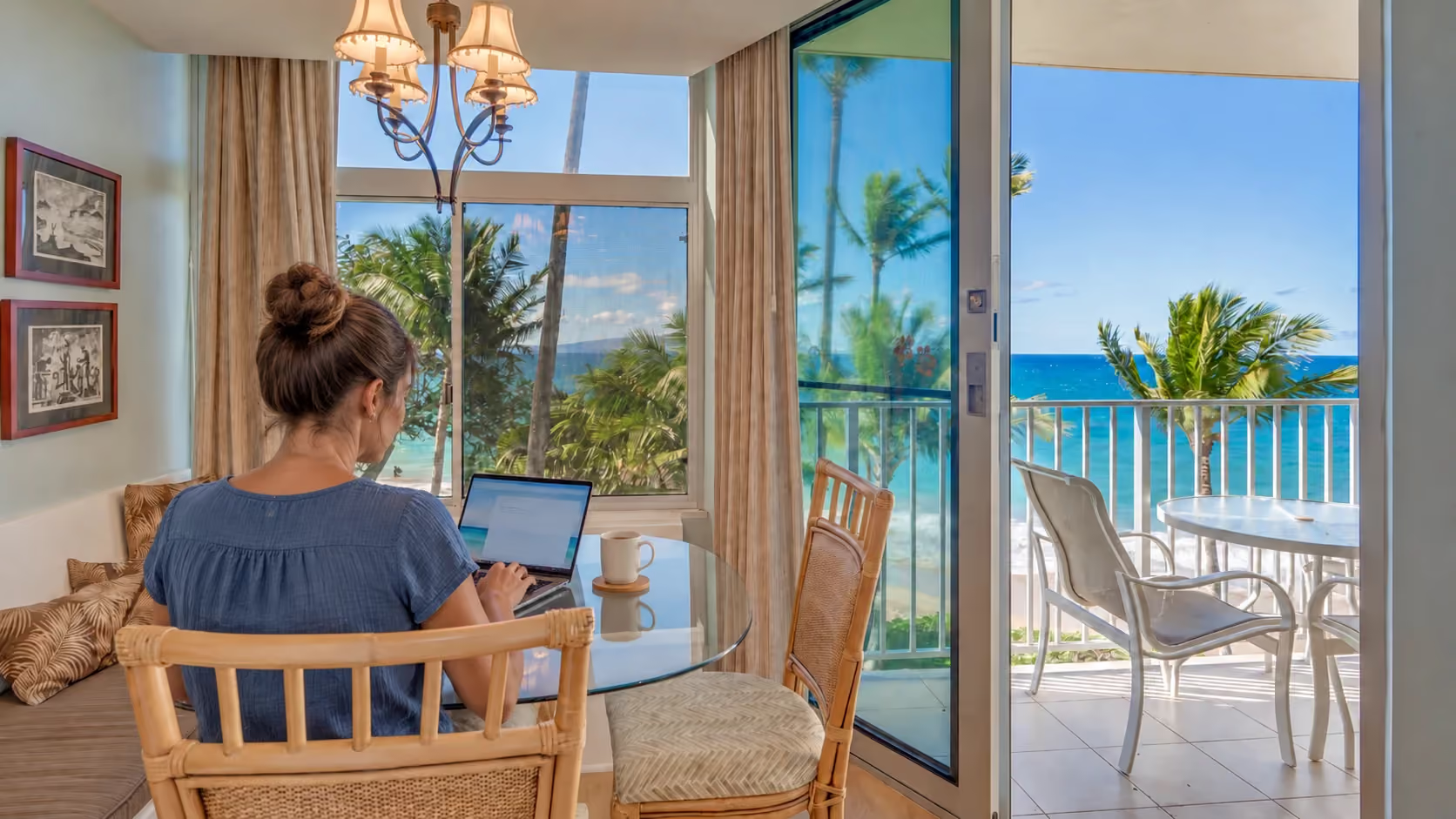
For remote work in Kīhei, stay in a condominium unit with a real table, a chair you can sit in for hours, power beside the work surface, and a Wi-Fi speed you have confirmed with the property before booking. The Hale Pau Hana, an oceanfront condominium property at 2480 South Kīhei Road fronting Kamaʻole Beach Park II, fits that brief because every one of its 80 units is oceanfront with a full kitchen and a private lanai for calls. The bigger factor is the clock. Hawaii runs on UTC-10 with no daylight saving, so most people here work early and take the afternoon.
Key takeaways
- Hawaii Standard Time is UTC-10 year round, and Hawaii does not observe daylight saving, so the gap between Kīhei and every US mainland time zone shifts by one hour twice a year.
- During US winter Kīhei is 2 hours behind Pacific, 3 behind Mountain, 4 behind Central, and 5 behind Eastern; during US summer each of those gaps widens by an hour, to 3, 4, 5, and 6.
- A 9am Eastern meeting lands at 4am in Kīhei during US winter and 3am during US summer, which is why remote workers on Maui build their day around an early start and a free afternoon.
- Confirm the Wi-Fi speed with the property in writing before you book a Kīhei condo; units are individually owned and furnished, so the desk, the chair, and the connection vary from unit to unit.
- The Hale Pau Hana is an oceanfront condominium property at 2480 South Kīhei Road, Kīhei, HI 96753, where all 80 units have a private ocean-facing lanai and complimentary coffee is served on the oceanfront lawn Monday to Saturday, 8am to 10am.
What time zone is Kīhei on, and why does the gap to the mainland keep moving?
Kīhei runs on Hawaii Standard Time, UTC-10. Hawaii has not observed daylight saving since 1945 and formally opted out under the Uniform Time Act of 1966, so the clocks here never move. The mainland moves twice a year, which means the distance between your lanai on South Kīhei Road and your colleagues' calendars changes without anything happening in Hawaii at all. Plenty of first-time workation travelers get caught by this, book a trip in March or November, and discover their whole schedule slid by an hour mid-stay.
The mainland sits on daylight time from the second Sunday in March to the first Sunday in November. In 2026 that window runs March 8 to November 1. In 2027 it runs March 14 to November 7. Inside the window, every mainland zone is one hour further ahead of you. Outside it, every gap narrows by an hour. Arizona is the useful exception, since it stays on Mountain Standard Time all year and therefore sits exactly 3 hours ahead of Kīhei in every season.
How many hours ahead of Kīhei is each US mainland time zone?
| Mainland zone | Hours ahead of Kīhei, US winter | Hours ahead of Kīhei, US summer | 8am in Kīhei equals, US winter | 8am in Kīhei equals, US summer |
|---|---|---|---|---|
| Pacific (Los Angeles, Seattle, Vancouver) | 2 | 3 | 10am PST | 11am PDT |
| Mountain (Denver, Salt Lake City) | 3 | 4 | 11am MST | 12pm MDT |
| Arizona (Phoenix, no daylight saving) | 3 | 3 | 11am MST | 11am MST |
| Central (Chicago, Dallas, Minneapolis) | 4 | 5 | 12pm CST | 1pm CDT |
| Eastern (New York, Atlanta, Toronto) | 5 | 6 | 1pm EST | 2pm EDT |
The practical read on that table: your morning is the mainland's afternoon, and your afternoon has largely stopped existing for anyone east of Denver.
What do mainland meeting times look like from Kīhei?
| Meeting on the mainland calendar | Kīhei time, US winter | Kīhei time, US summer |
|---|---|---|
| 8am Eastern | 3am | 2am |
| 9am Eastern | 4am | 3am |
| 12pm Eastern | 7am | 6am |
| 3pm Eastern | 10am | 9am |
| 5pm Eastern | 12pm | 11am |
| 9am Pacific | 7am | 6am |
| 12pm Pacific | 10am | 9am |
| 5pm Pacific | 3pm | 2pm |
The window when every US time zone is simultaneously at a desk runs roughly 6am to noon Kīhei time during US winter, and roughly 5am to 11am during US summer. Guard that window, push everything else out of it, and the rest of the day belongs to you.
What does a remote work day in Kīhei actually look like?
Early. That is the honest answer, and it is the reason a workation in Kīhei tends to work better than people expect. The deal on offer is a pre-dawn alarm in exchange for a genuinely free afternoon, and most people take it happily by the second morning. Sunrise in Kīhei comes somewhere between about 5:45am in June and about 7am in late December, so for part of the year you start your workday in the dark and watch the light come up over Haleakalā behind the town while the East Coast breaks for lunch.
Most remote workers here settle into a version of this shape within two or three days.
| Kīhei time | What is usually happening |
|---|---|
| 5am to 6am | Wake up. The East Coast is already mid-morning; email and messages have piled up overnight |
| 6am to 8am | The heaviest overlap. East Coast and Central calls, plus anything urgent, before the day gets away |
| 8am to 10am | Pacific colleagues come online. Complimentary coffee is served on the oceanfront lawn at The Hale Pau Hana, Monday to Saturday, 8am to 10am, which is a good excuse to take a call outside |
| 10am to 12pm | Focused solo work. In winter the East Coast signs off at noon your time; in summer it is gone by 11am |
| 12pm to 3pm | The Pacific coast is still working, so keep a phone nearby, but this is beach and pool time |
| 3pm onward | Everyone on the mainland has finished. Kamaʻole Beach Park II, a snorkel, dinner, sunset over Lānaʻi |
Two things make that schedule sustainable across a week or longer. First, a kitchen, so a 5am start does not depend on a cafe being open. Second, somewhere to be at 1pm that is worth getting up at 5am for. At The Hale Pau Hana the two-acre oceanfront lawn ends at the sand of Kamaʻole Beach Park II, with Maui County lifeguards on duty daily from 8am to 6:45pm in summer and 7:30am to 6:15pm in winter, so the commute from your desk to the water is about 60 seconds.
What should you look for in a Kīhei condo workspace?
Kīhei condominiums are individually owned, which is the whole reason this section exists. Two units in the same building can be furnished completely differently: one has a dining table by a window with an outlet under it, and the next has a low coffee table, a sofa, and a single outlet behind the television. Listing photos rarely answer the question you care about. Ask before you book.
| What to check | Why it matters over a week or more | How to confirm before booking |
|---|---|---|
| A real table | A dining table at proper height is the difference between a productive week and a sore back. Lanai bistro tables are usually too low or too small for a laptop plus notebook | Ask for a photo of the dining area taken from standing height |
| A chair with a back | Beach chairs, stools, and rattan lounge seating are pleasant for an hour and punishing for eight | Ask what the seating at the dining table is |
| Power beside the work surface | Older buildings have fewer outlets, often placed for lamps. A laptop, a monitor, and a phone need reachable power | Ask where the nearest outlet to the dining table is, and pack a compact power strip either way |
| A lanai you can take calls from | An outdoor call spot with shade and a railing to lean on is the single most underrated feature of a Maui workation | Confirm the lanai is private to the unit and has furniture |
| Air conditioning or a reliable trade wind breeze | Kīhei is sunny and warm year round. Afternoon rooms can get hot, and a laptop throttling in a closed room is a real problem | Ask whether the unit has air conditioning, and whether it covers the room with the table |
| Light and noise for video calls | Backlighting from an ocean-facing window turns you into a silhouette. Surf, wind, and lawn maintenance all carry | Plan to sit facing a window with the ocean behind your screen, and keep a wired headset in the bag |
Every unit at The Hale Pau Hana is oceanfront with a private ocean-facing lanai, a full kitchen, and free parking, one car per unit. The property has an on-site laundry facility, which matters when you are packing for two weeks in one carry-on. The internet is fiber. Every unit has a dining table that seats up to four and a table on the lanai, though not every unit has a dedicated desk, so the dining table is the realistic work surface. Most units are fully air conditioned and some have air conditioning in the bedroom only, and because owners furnish their own units, confirm the specifics of the work surface, seating, and air conditioning for the exact unit you are booking. Browse the units and ask the office at +1-808-879-2715 before you commit.
How good is the internet in Kīhei, and how do you check before you book?
Kīhei is in reasonable shape. Hawaiian Telcom has been building out fiber across Maui, with symmetrical residential plans advertised well into the gigabit range, and Spectrum cable covers much of the town where fiber has not landed. Cell service is solid through central Kīhei, with 5G from the major carriers along the South Kīhei Road corridor. The infrastructure is rarely the problem.
The problem is the last hundred feet. In a building of individually owned units, the internet plan belongs to the owner or the association, the router might be a decade old and sitting in a closet at the far end of the unit, and a listing that says "high speed Wi-Fi" is telling you nothing measurable. Download speed is also the wrong number to fixate on. Video calls live and die on upload speed and on jitter, and a connection that streams a movie beautifully can still make you unwatchable on a call.
So do this, in writing, before you pay a deposit:
- Ask the property or the owner to run a speed test in the actual unit and send you the screenshot, showing download, upload, and ping.
- Ask whether the connection is fiber or cable, and whether the Wi-Fi is private to the unit or shared across the building. The Hale Pau Hana is on fiber.
- Ask where the router sits relative to the room with the table. If it is two concrete walls away, ask whether an Ethernet cable will reach.
- Say plainly that you will be taking video calls and need the connection to support them. A property that hesitates has told you something useful.
- Bring a backup. A phone hotspot on a carrier with good Maui coverage, or a dedicated travel hotspot, will carry a one-hour call comfortably. Check your plan's hotspot data allowance before you fly, and test the hotspot at home first.
Public power and internet on Maui are generally dependable, and outages are uncommon, though they do happen in high wind. If a deadline is genuinely immovable, plan a redundancy for it the same way you would anywhere else.
Where else can you work in Kīhei besides your unit?
By day four of any stay you will want a different room. Kīhei gives you three options: a cafe, a coworking desk, or the lawn.
Cafes along South Kīhei Road are the easy change of scene, and several have indoor tables plus shaded outdoor seating. One thing worth knowing before you carry a laptop somewhere: not every Kīhei cafe offers Wi-Fi, and at least one well-regarded roaster on South Kīhei Road declines to as a house policy about unplugging. You can still work on your own hotspot, but check before you count on a connection. For the fuller rundown of which Kīhei cafes have seating, shade, and hours that suit an early start, see coffee shops in Kīhei. Confirm current hours directly, since small Kīhei businesses adjust them seasonally.
Where can you rent a desk by the day or the month in Kīhei?
There is an established coworking space at the Maui Research and Technology Center on Lipoa Parkway, about 3 miles from The Hale Pau Hana and roughly a 10 minute drive, offering drop-in days and monthly memberships with air conditioning, a phone booth for private calls, a conference room, printing, and a shared kitchen. Rates, hours, and desk availability change, so confirm directly before you build a working week around it.
A second space has been announced for South Kīhei Road, a few minutes' walk north of The Hale Pau Hana, but it is not yet open, so plan on the Lipoa Parkway option or on working from the unit.
Then there is the lawn. Two acres of it at The Hale Pau Hana, ending at the sand, with shade and a breeze. It is a poor place for a laptop screen in direct sun and an excellent place for a phone call, a thinking hour, or reviewing something on paper.
How does staying a month change what you pay?
Meaningfully, and in a way that makes Kīhei one of the better-value workation bases in Hawaii. Kīhei condominiums price by season and by length of stay, and stays of roughly 30 nights or more commonly unlock a monthly rate that lands well below the sum of the nightly rates. Shoulder months such as April, May, September, and October usually stack the deepest discount on top of already softer rates. Combine that with a kitchen, free parking, and no resort fees, and the arithmetic of working from Maui for a month starts to look a lot like the arithmetic of a week's vacation.
Two things to get right when you compare quotes. First, cleaning fees: The Hale Pau Hana charges none, while many Kīhei condos add a one-time fee that matters less on a long stay. Second, taxes. Hawaii's transient accommodations tax only falls away at 180 consecutive days, so a 30 night stay carries the same tax treatment as a 7 night stay. Ask for a full quote showing taxes and fees before you compare properties, since some listing sites show them late.
For how monthly pricing works across Kīhei properties, how the combined state and county lodging taxes break down, and which unit types suit a long stay, see long stay Kīhei condos.
When is the best time of year for a workation in Kīhei?
The calendar argues for winter, and so does the weather. From early November to early March the mainland is on standard time, which means every meeting sits one hour later in Kīhei terms: 9am Eastern is 4am your time instead of 3am, and 9am Pacific is 7am instead of 6am. That hour is worth a great deal across a four-week stay.
Winter also happens to be when Kīhei is at its best. The town sits in Haleakalā's rain shadow, gets about 10 to 13 inches of rain a year, and sees 300 or more sunny days, making it one of the driest places in Hawaii even in the wet season. Humpback whales are in the channel from late November through early May, with the peak from January through March, and from an oceanfront lanai you can watch them between calls without leaving the property. If the point of the trip is to swap a grey mainland February for a working one with a view, see winter escape to Maui.
Summer trades that extra hour for warmer water, longer evenings, and a livelier town. It also brings the widest gap to the mainland, at 3 to 6 hours, so a summer stay demands a firmer boundary around the afternoon. Either way, book early: whale season and the December holidays sell out first, and oceanfront units go before anything else. For the season-by-season breakdown, see the best time to visit Kīhei, and for the handful of genuinely rainy afternoons, Kīhei on a rainy day covers what to do with them.
Frequently asked questions
What time zone is Kīhei, Maui in?
Kīhei is on Hawaii Standard Time, UTC-10, all year. Hawaii does not observe daylight saving time and has not since 1945, so the clocks in Kīhei never change. Every seasonal shift you notice while working from Maui comes from the mainland moving its clocks, not from anything happening in Hawaii. Arizona, which also skips daylight saving, stays exactly 3 hours ahead of Kīhei year round.
How many hours behind the US mainland is Kīhei?
During US winter, Kīhei is 2 hours behind Pacific time, 3 behind Mountain, 4 behind Central, and 5 behind Eastern. During US summer, when the mainland is on daylight time, each gap widens by an hour, to 3, 4, 5, and 6 hours. So 8am in Kīhei is 1pm in New York in January and 2pm in New York in July. The mainland runs daylight time from the second Sunday in March to the first Sunday in November.
What is the best daily schedule for working remotely from Kīhei?
Start early and finish early. The window when every US time zone is at a desk runs roughly 6am to noon Kīhei time in winter and roughly 5am to 11am in summer, so front-load calls into it and keep the afternoon clear. A typical pattern is 6am to noon at the desk, then the beach, the pool, or a drive from about 1pm. A kitchen matters, because a 5am start should not depend on a cafe being open.
Is the Wi-Fi in Kīhei condos good enough for video calls?
Usually, though it varies unit by unit. Hawaiian Telcom fiber and Spectrum cable both serve Kīhei well, and cell coverage along South Kīhei Road is strong. The variable is the individual unit's router and plan. Ask the property to run a speed test in the actual unit and send the screenshot showing download, upload, and ping, and confirm where the router sits. Carry a phone or travel hotspot as backup.
Does Kīhei have a coworking space?
Yes. The established option is the coworking space at the Maui Research and Technology Center on Lipoa Parkway, about 3 miles and roughly 10 minutes by car from The Hale Pau Hana, which offers drop-in days and monthly memberships. A second space announced for South Kīhei Road is not yet open. Confirm current pricing and availability directly before you rely on either.
Can you work from coffee shops in Kīhei?
Some, with a caveat. Several Kīhei cafes have indoor tables and shaded outdoor seating, and hours that suit an early start. At least one well-regarded South Kīhei Road cafe declines to offer Wi-Fi as a house policy, so bring a hotspot. Confirm hours directly, since small Kīhei businesses adjust them seasonally. See the coffee shops in Kīhei guide for which spots suit a laptop.
Does a monthly stay in Kīhei cost less per night?
Generally yes. Kīhei condominiums commonly offer a monthly rate for stays of roughly 30 nights or more that falls well below the sum of the nightly rates, with the deepest discounts in shoulder months such as April, May, September, and October. Hawaii's lodging tax exemption only begins at 180 consecutive days, so a 30 night stay is taxed like a short one. The long stay Kīhei condos guide has the full breakdown.
Can you work remotely from The Hale Pau Hana?
Yes, and the setup suits it. The Hale Pau Hana is an oceanfront condominium property at 2480 South Kīhei Road, where all 80 units are oceanfront with a private lanai, a full kitchen, and free parking, and the property has an on-site laundry facility. The internet is fiber, and every unit has a dining table that seats up to four plus a table on the lanai, though not every unit has a dedicated desk. Most units are fully air conditioned and some have air conditioning in the bedroom only. Units are individually owned and furnished, so confirm the work surface, seating, and air conditioning for your specific unit with the office at +1-808-879-2715 before booking.
Ready to trade the commute for a lanai?
The Hale Pau Hana puts your desk, your kitchen, and the sand of Kamaʻole Beach Park II within about 60 seconds of each other, with free parking and no resort fees. Check availability
Check availability →