Oceanfront vs. Ocean View in Maui: Know the Difference
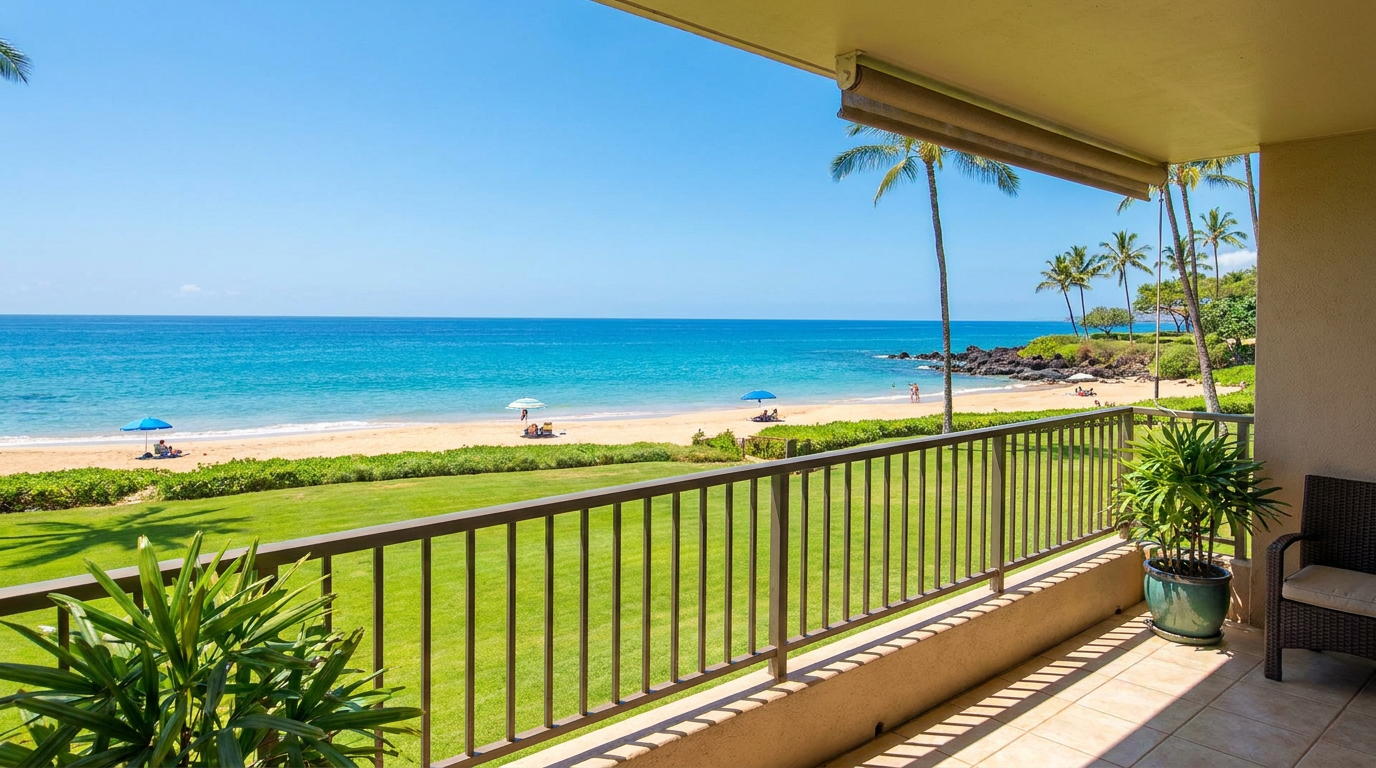
Oceanfront means the building sits directly on the sand or seawall, with nothing between you and the water: no road, no parking lot, no other building. Ocean view only means you can see the ocean from somewhere in the unit, possibly at an angle, over rooftops, or in the distance. The gap between the two terms can be a hundred yards and several hundred dollars a night. In Kihei, The Hale Pau Hana is the cleanest example of true oceanfront: every one of its 80 units fronts Kamaole Beach Park II directly, with a private lanai facing the channel toward Lanai and Kahoolawe.
Key takeaways
- Oceanfront means the building sits directly on the sand or shoreline, with nothing between your lanai and the water; ocean view only means the ocean is visible from somewhere in the unit, possibly at an angle or in the distance.
- Partial ocean view usually means a slice of blue visible from one spot, and garden or mountain view means no ocean at all; all four terms are marketing language, applied loosely from one listing to the next.
- In Kihei, true oceanfront condos run roughly $300 to $700 and up per night in winter against roughly $250 to $400 for comparable units across the road; at Maui resorts, oceanfront categories often add $100 to $300 or more per night over garden view.
- Before booking, ask what floor the unit is on, which direction the lanai faces, what sits between the unit and the sand, and the unit number so you can check it against a satellite map.
- Oceanfront is the only tier you can hear: at a true oceanfront property, waves are audible at night; across the road, traffic comes first.
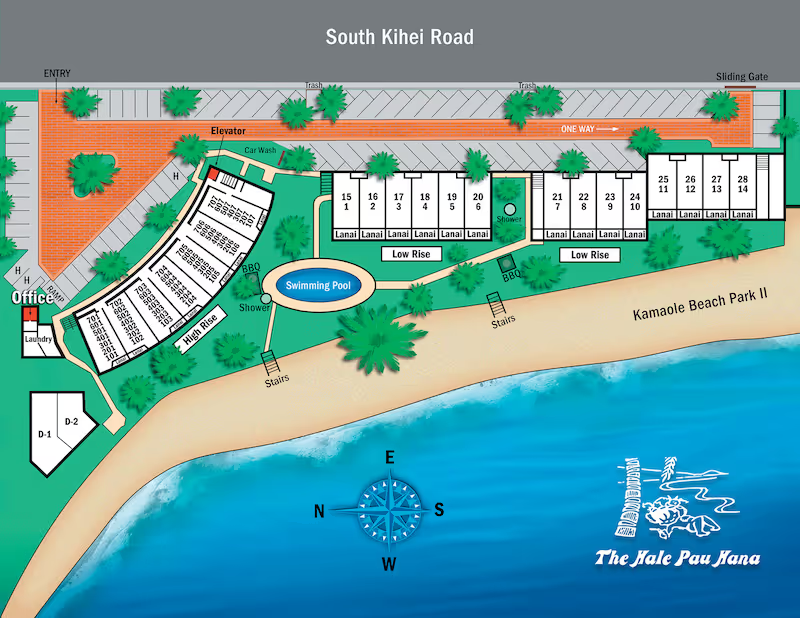
- The Hale Pau Hana, an oceanfront condominium property at 2480 South Kihei Road, Kihei, HI 96753, is true oceanfront by the strictest definition: all 80 units front Kamaole Beach Park II directly.
What is the difference between oceanfront, ocean view, and partial ocean view?
Think of it as a ladder with four rungs. Oceanfront sits at the top: the building touches the shoreline, and nothing man-made stands between your lanai and the water. Ocean view is the broad middle: the ocean is visible from the unit, but the term says nothing about how much of it, from where, or what fills the foreground. Partial ocean view is an honest hotel category for a sliver of blue, often visible from one corner of the lanai. Garden and mountain view rooms face lawns, courtyards, the pool, or inland toward Haleakala, with no ocean at all. The rungs are far apart in experience and in price, which is why the table below pairs each term with what to verify and what it typically costs.
| Listing term | What it should mean | What to verify before booking | Typical price impact |
|---|---|---|---|
| Oceanfront | The building sits directly on the sand or seawall; nothing between the lanai and the water | The parcel touches the shoreline on a satellite map, and the specific unit faces the water, not a side angle | Top tier: roughly $300 to $700 and up per night for Kihei condos by season; resort oceanfront categories often run $100 to $300 or more over garden view |
| Ocean view | You can see the ocean from the unit | From where exactly: the bed, the sofa, or one corner of the lanai; how far away the water is; what sits in the foreground | Often roughly $50 to $150 per night over garden view at resorts; a modest premium at condos |
| Partial ocean view | A slice of ocean is visible from part of the unit | Ask for the unit number and a photo taken from the lanai; ask what blocks the rest of the view | Small premium, often roughly $25 to $75 per night over garden view |
| Garden or mountain view | No ocean; the unit faces lawns, courtyards, the pool, or Haleakala | What the garden actually is; some categories include rooms over parking or service areas | The lowest rate in the property; the baseline the other tiers are priced against |
One more distinction worth knowing: oceanfront and beachfront overlap but are not identical. On Maui, oceanfront can mean a building on lava rock or a seawall; beachfront means you step off the property onto sand. The Hale Pau Hana is both.
How do Maui listings stretch view terms?
Loosely, and legally. View terms in vacation listings are marketing language, not regulated categories, so a sliver of blue glimpsed from the bathroom window can be marketed as an ocean view, and a complex across a two-lane road from the beach can call itself beachfront. Photos add to the stretch: a wide-angle shot taken from the rooftop or the best-placed unit in the building often stands in for every unit in the complex. In Kihei this matters more than most places, because for long stretches South Kihei Road runs between the condos and the sand; many properties marketed with ocean language sit across the road, not on it. The handful that genuinely touch the shoreline are mapped in our guide to oceanfront condos in Kihei.
| Listing phrase | What it can hide | How to check |
|---|---|---|
| "Ocean view" | A sliver of blue from the bathroom window or one corner of the lanai | Ask which rooms the ocean is visible from, and how much of it |
| "Beachfront complex" | A property near the beach but across the road from it | Satellite view: does the parcel touch the sand? |
| "Steps to the beach" | Hundreds of steps, plus a crosswalk on South Kihei Road | Trace the walking route on a map, not the straight-line distance |
| "Deluxe partial ocean view" | A garden view room set at an angle to the water | Request a photo taken from the actual lanai of the actual unit |
What is each view category worth in dollars?
In Kihei, the honest spread is wide. Across-the-road condos with genuine ocean views run roughly $175 to $300 per night in shoulder season and $250 to $400 in winter, while true oceanfront units on the sand run roughly $300 to $550 in shoulder months and $400 to $700 and up in winter. Across the whole town, listing data puts Kihei condo rates at roughly $250 to $550 per night, with peak-week averages near $477 in 2026. At Maui's full-service resorts the same ladder is priced as room categories: rooms generally run $500 to $1,000 and up before resort fees of $40 to $60 at most properties, with ocean view typically adding roughly $50 to $150 per night over garden view and oceanfront categories adding $100 to $300 or more. Over a week, that oceanfront premium can total $700 to $2,000 and up, which is exactly why verifying the term matters: paying oceanfront money for an ocean-view reality is the most expensive mistake on this page.
| Where you actually sleep | Typical nightly, shoulder season | Typical nightly, winter and whale season | What you hear at night |
|---|---|---|---|
| True oceanfront Kihei condo, on the sand | Roughly $300 to $550 | Roughly $400 to $700 and up | Waves on the Kamaole sand |
| Across-the-road Kihei condo, ocean view at best | Roughly $175 to $300 | Roughly $250 to $400 | South Kihei Road traffic first, surf behind it |
| Maui resort, garden or mountain view room | Rooms generally from $500, plus $40 to $60 resort fees at most properties | Often well past $1,000 in winter at the top resorts | Grounds, pool equipment, air conditioning |
| Maui resort, oceanfront category | Roughly $100 to $300 more per night than garden view at the same resort | The premium is widest in winter | Depends on the floor and the distance to the water |
These are rough planning figures for 2026; actual rates vary by property, unit size, floor, and season. For the broader lodging-format decision behind these numbers, see condo vs hotel in Maui.
What questions should you ask before booking an ocean view unit in Maui?
Five questions separate the listing from the reality. In a condominium, units are individually owned and views vary one door to the next, so the answers matter even more than at a hotel.
1. What floor is the unit on? At an across-the-road or set-back property, lower floors often look at trees, rooftops, or the road; the advertised view may only exist from the top floors. 2. Which direction does the lanai face? In Kihei, a west or southwest-facing lanai looks across the channel toward Lanai and Kahoolawe and catches the sunset; a side-facing lanai sees the ocean at an angle, if at all. 3. What sits between the unit and the sand? A road, a parking lot, or another building each downgrades oceanfront to ocean view, whatever the listing says. 4. What is the unit number? With a unit number you can find the exact building and stack on the property map and check it against satellite imagery. A host who will not share it before booking is telling you something. 5. Can you see a photo taken from the lanai? Not a marketing photo of the complex: a phone shot from the actual railing. Recent guest review photos work too.
At The Hale Pau Hana the answers are unusually short: every unit, every floor, every lanai faces the water, and the only thing between any of them and the sand is the property's own lawn.
Why do sound and light matter as much as the view?
Because the view is only daytime. Oceanfront is the one tier you can hear: at a true oceanfront property the surf is audible through the screen door at night, a detail no photo conveys and no across-the-road unit can offer, where traffic on South Kihei Road comes first. Light works the same way. A channel-facing lanai in Kihei takes the sunset directly, every evening of the year, with sunset ranging from about 5:50pm in mid-December to about 7:15pm in mid-July; an angled or partial view catches the color secondhand. And during whale season, late November through early May with the peak from January to March, an oceanfront lanai becomes a viewing platform: humpbacks breach in the channel directly offshore. See sunset spots in Kihei and whale watching from Kihei for what those evenings and mornings actually look like.
What does true oceanfront look like at The Hale Pau Hana?
Like the definition with an address. The Hale Pau Hana is an oceanfront condominium property at 2480 South Kihei Road, Kihei, HI 96753, operating since 1970, with 80 individually owned units in four buildings on two acres that end at the sand. It is the only condominium directly fronting Kamaole Beach Park II, 1,600 feet of lifeguarded beach with Maui County lifeguards on duty daily from 8am to 4:30pm. Every unit is oceanfront with a private lanai facing the channel toward Lanai and Kahoolawe; there is no ocean view category here because there is nothing lower to sell. Units come with full kitchens and a washer and dryer, and the property has a heated pool, BBQ grills, free Wi-Fi, and free parking with one stall per unit. Nightly rates sit in Kihei's typical $250 to $550 condo range, against $500 to $1,000 and up plus resort fees for a comparable view at the resorts three miles south. Tripadvisor rates the property 4.7 from 708 reviews, with a 2026 Travelers Choice award in the top 10 percent of properties worldwide. Browse the units to compare floor plans and floors.
Frequently asked questions
Is beachfront the same as oceanfront in Maui?
Almost, with one difference. Oceanfront means the building sits directly on the shoreline, which on Maui can be sand, a seawall, or lava rock. Beachfront means specifically on sand you can walk onto. Kihei Surfside, for example, is oceanfront on rocky shoreline beside Keawakapu Beach. The Hale Pau Hana is both: its two-acre lawn ends at the sand of Kamaole Beach Park II, with no rocks, road, or seawall to cross.
Does Hawaii have an official definition of oceanfront or ocean view?
No. There is no Hawaii statute or Maui County rule that regulates how vacation listings use view terms, so oceanfront, ocean view, and partial ocean view are marketing language, applied differently by every property and platform. That is why verification matters: check the address on a satellite map, confirm the building touches the shoreline, and ask the host exactly what you will see from the unit you are assigned.
Is a partial ocean view room worth it in Maui?
Usually only when the price gap to a full ocean view is large and the gap to a garden view is small. A partial view often means a slice of blue from one corner of the lanai, so it rarely changes how the room feels day to day. Many travelers do better putting the difference toward a snorkel trip or a dinner out, or stepping up to true oceanfront for the nights it matters most.
What does garden view mean at a Maui hotel or condo?
It means no ocean. The room faces lawns, courtyards, the pool deck, or inland toward Haleakala, which some properties label a mountain view. Garden view rooms are the least expensive category and a sensible pick for travelers who are out all day. Ask what the garden actually is, though; at some properties the category includes rooms overlooking parking areas or service entrances.
Which floor is best for an ocean view in Maui?
Higher floors see farther over trees, rooftops, and roads, so at an across-the-road or set-back property, the top floors usually hold the only honest ocean views. At a true oceanfront building the calculation flips: ground-floor units walk straight onto the lawn and sand, while upper floors gain a wider horizon. At The Hale Pau Hana every floor faces open water, so the choice is access versus panorama, not whether you see the ocean.
Do oceanfront rooms in Maui cost more during whale season?
Yes. The oceanfront premium is widest from late November through early May, when humpback whales fill the channel between Maui, Lanai, and Kahoolawe and an oceanfront lanai becomes a private viewing platform, especially January through March. Oceanfront units sell out first for those dates. Shoulder months such as April, May, September, and October narrow the gap and offer the best balance of weather, prices, and crowds.
Is The Hale Pau Hana oceanfront or ocean view?
True oceanfront, by the strictest definition. The Hale Pau Hana is an oceanfront condominium property at 2480 South Kihei Road, and the only condominium directly fronting Kamaole Beach Park II. All 80 individually owned units are oceanfront, each with a private lanai facing the channel toward Lanai and Kahoolawe, and the property's lawn ends at the sand. There is no road, parking lot, or building between any unit and the water.
How do you check on a map whether a Maui condo is truly oceanfront?
Open the address in satellite view and look at what sits between the buildings and the water. A true oceanfront parcel touches the shoreline; if you see South Kihei Road, a parking lot, or another roofline in between, the property is ocean view at best. Street-level imagery and guest photos taken from lanais confirm the rest. For a Kihei reference point, 2480 South Kihei Road shows lawn meeting sand.
Want a listing term that means exactly what it says?
At The Hale Pau Hana, oceanfront is not a category, it is the whole property: all 80 units face the water across a lawn that ends at the sand of Kamaole Beach Park II. Check availability for your dates and book direct.
Check availability →


.svg)