Direct Beach Access Condos in Kīhei: What It Really Means
Direct beach access means you step from the property's own ground onto the sand with no road to cross, and in Kīhei that describes only a handful of buildings. The difference shows up every day, when you are carrying chairs, a cooler, and two tired children. Here is which properties genuinely have it, and how to check a listing's claim before you book.
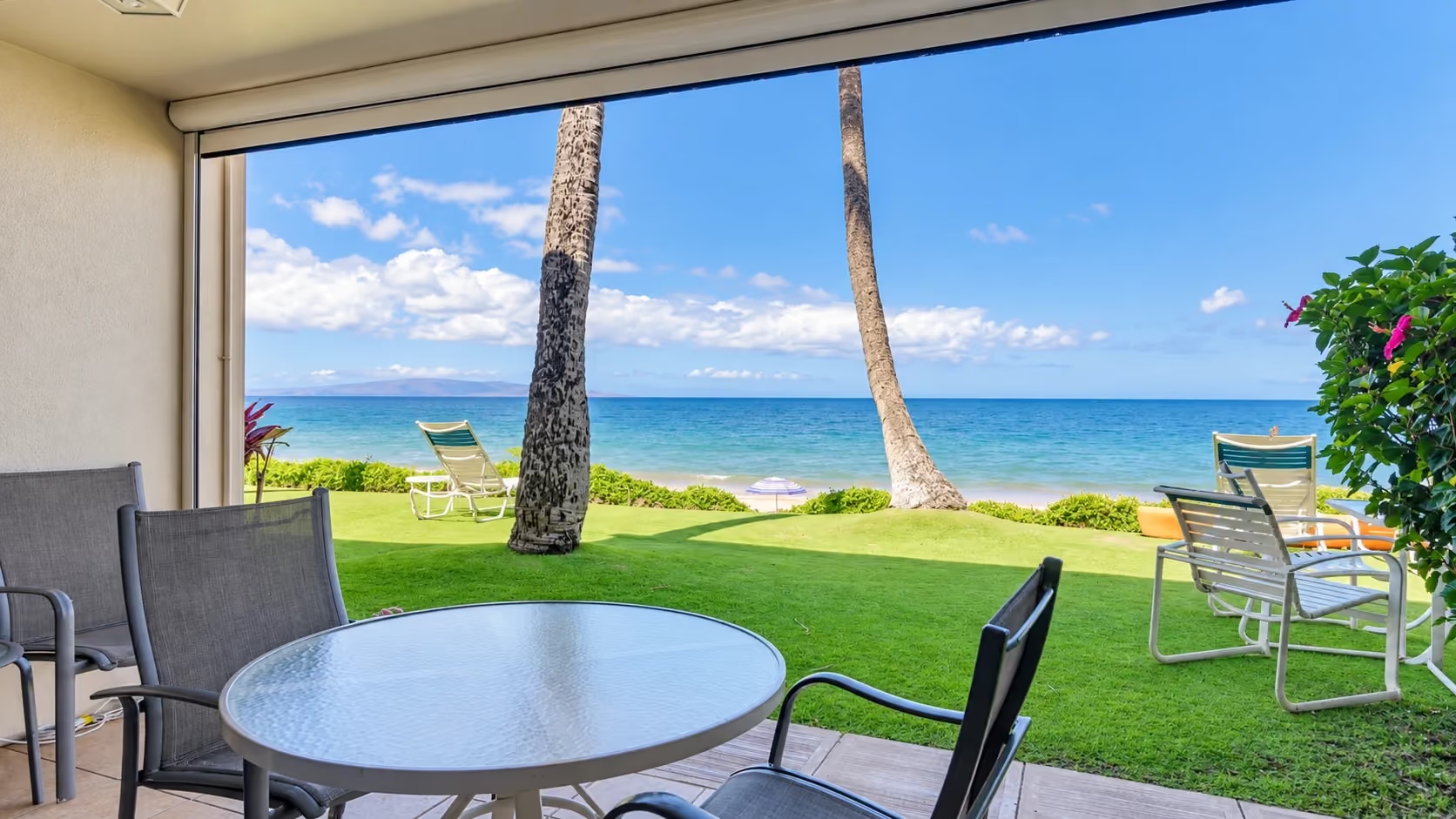
Four Kīhei condominium properties have true direct beach access, meaning you step from the property's own ground onto the sand with no road, parking lot, or other building in between: The Hale Pau Hana on Kamaʻole Beach Park II, Mana Kai Maui and Hale Hui Kai on Keawakapu Beach, and Sugar Beach Resort in North Kīhei. Every other condominium in Kīhei reaches the sand by crossing South Kīhei Road or walking a public access path. At The Hale Pau Hana, 2480 South Kīhei Road, the two-acre oceanfront lawn ends at the sand of Kamaʻole Beach Park II, where lifeguards work daily from 8am to 6:45pm in summer and 7:30am to 6:15pm in winter.
Key takeaways
- Direct beach access means the property's own grounds meet the sand, with no public road, parking lot, or second building between your door and the water.
- Most Kīhei condominiums sit across South Kīhei Road from the beach and reach the sand by crosswalk and public access path, which adds roughly 4 to 8 minutes each way with gear and children.
- The Hale Pau Hana, an oceanfront condominium property at 2480 South Kīhei Road, has a two-acre lawn that ends at the sand of Kamaʻole Beach Park II, where Maui County lifeguards are on duty daily from 8am to 6:45pm in summer and 7:30am to 6:15pm in winter.
- Every beach in Hawaii is public seaward of the shoreline under state law, so no condominium can privatize the sand in front of it, and Maui's subdivision rules require public shoreline access at intervals of no more than 1,500 feet and a minimum width of 15 feet.
- Sand is the real obstacle for strollers and wheelchairs, so a firm surface running right up to the beach edge matters; Maui County lists accessible ramps from Kamaʻole Beach Park II down to the beach, and free beach wheelchairs have been stocked at some Kamaʻole lifeguard towers.
What does direct beach access actually mean?
Direct beach access means the ground you are staying on touches the sand. You walk out of your unit, across a lawn or a short path that belongs to the property, and your feet are on the beach. Nothing public stands in between: no road, no parking lot, no second building, no locked gate, no flight of stairs down a sea wall.
The phrase gets stretched in Kīhei because almost everywhere in town is close to a beach. Six miles of coastline and a road that runs along most of it make "steps to the sand" loosely true at hundreds of addresses. The useful question is physical: what stands between your door and the water line, and how long does getting past it take while you are carrying things.
| What stands between you and the sand | What that looks like in Kīhei | Typical time each way |
|---|---|---|
| Nothing | The property's own lawn ends at the sand | Under a minute, no crossing |
| A public beach access path | A marked walkway between two buildings, at least 15 feet wide under county subdivision rules | About 2 to 4 minutes |
| South Kīhei Road | Two lanes of traffic, a marked crosswalk, then park lawn or an access path | About 3 to 6 minutes, plus waiting for a gap |
| A parking lot and the road | Larger complexes set back from the water on the inland side | About 5 to 10 minutes |
Those times are estimates for planning; walking speed, gear, and how far the nearest crosswalk sits will move them. For how the listing vocabulary breaks down and which properties sit on the sand across all of Kīhei, see oceanfront condos in Kīhei.
Why does direct beach access matter when you are hauling kids and gear?
Because a beach day from a condominium is never one trip. It is a swim before breakfast, coffee back at the unit, chairs and umbrella out at nine, lunch inside, back out at two, a shower, and sunset at the water's edge. Each of those movements is a round trip, and each one is either a walk across grass or a small logistical operation.
Load it up the way a family actually travels: two beach chairs, an umbrella, a cooler, snorkel gear, sand toys, towels, and a toddler who wants to be carried. With direct access, you make two easy trips across a lawn and leave the setup in place all day, in sight of your own lanai. Across the road, you stage everything on the curb, take a hand in each of your own, wait for a gap in traffic, cross, and re-gather on the far side. If you want the fuller picture of which Kīhei condos suit young children, see family-friendly Kīhei condos.
| Moment in a beach day | Direct access | Across South Kīhei Road |
|---|---|---|
| Pre-breakfast swim at 7am | Walk out in a swimsuit, about a minute | Dress enough for a public road, about 6 minutes round trip |
| Setting up chairs and umbrella | One trip across the lawn | One or two trips, each with a road crossing |
| Going back for forgotten goggles | About a minute | About 6 minutes |
| Lunch in the unit | Leave the setup, walk up, walk back | Break camp or leave gear unattended |
| Toddler nap at 1pm | One adult heads up, the beach stays in view of the lanai | The unit and the beach are out of sight of each other |
| Sunset at 6:30pm | Step off the lawn onto the sand | Cross the road again in dusk traffic |
This is the single biggest daily difference between Kīhei condominium properties, and it is invisible in photographs. Both kinds of property show the same blue water from the lanai.
Which Kīhei condos have direct beach access?
Seven Kīhei condominium properties sit on the shoreline itself. Four of them put grass or building directly against sand. Three sit oceanfront on lava rock, which is genuinely oceanfront and delivers the view, with a short walk to swimmable sand.
| Property | Beach it fronts | Distance from The Hale Pau Hana | What stands between the building and the sand |
|---|---|---|---|
| The Hale Pau Hana (2480 South Kīhei Road) | Kamaʻole Beach Park II | On site | Nothing; the two-acre oceanfront lawn ends at the sand |
| Mana Kai Maui (2960 South Kīhei Road) | Keawakapu Beach | About 1 mile south, 4 minutes by car | Nothing; the property sits on the sand |
| Hale Hui Kai (2994 South Kīhei Road) | Keawakapu Beach, south end | About 1.2 miles south, 5 minutes by car | Nothing; the property sits on the sand |
| Sugar Beach Resort (145 North Kīhei Road) | Sugar Beach, North Kīhei | About 4.5 miles north, 10 to 12 minutes by car | Nothing; the grounds meet the sand |
| Kamaole Nalu (2450 South Kīhei Road) | Point between Kamaʻole I and Kamaʻole II | About 0.25 miles north, 6-minute walk | Lava rock; sand is a 1 to 2 minute walk in either direction |
| Royal Mauian (2430 South Kīhei Road) | Outcropping beside Kamaʻole Beach Park I | About 0.25 miles north, 6-minute walk | Lava rock; sand is a 1 to 2 minute walk |
| Kihei Surfside (2936 South Kīhei Road) | Shoreline at Keawakapu's north end | About 0.9 miles south, 4 minutes by car | Lava rock; Keawakapu sand is a 2 to 3 minute walk |
Everything else in Kīhei, including the large and well-regarded complexes across from the Kamaʻole beach parks, involves a road crossing. That page-length inventory, with unit mixes, build years, and what the oceanfront premium costs, lives at oceanfront condos in Kīhei. This page is about what the access itself does to your days.
What is it like crossing South Kīhei Road with beach gear?
South Kīhei Road is a slow two-lane town road that runs most of the length of Kīhei, busy from breakfast until well after sunset with rental cars, delivery trucks, cyclists, mopeds, and tour vans. Along Kamaʻole, condominiums line the mauka (inland) side and county beach parks line the makai (ocean) side. There are marked crosswalks, some with pedestrian-activated flashing beacons, and there are also long stretches without one. Sidewalks start and stop.
The trip from an across-the-road unit runs roughly like this: out the door, along an interior walkway, across the complex parking lot, out to the sidewalk, then a walk to the nearest marked crossing, a pause to wait for traffic to stop, the crossing itself, and finally the park lawn or access path down to the sand. Call it about 4 to 8 minutes each way with gear and small children. Treat that as a planning estimate for a calm day; we have not measured it.
Two frictions do most of the damage. The first is having your hands full at the moment you need them free, which is why families end up making more trips with less in each one. The second is the return, when everyone is wet, sandy, and tired at a curb in the late afternoon. The Kihei Community Association publishes its own guidance on walking along and crossing South Kīhei Road, which tells you the crossings deserve your full attention.
None of this makes an across-the-road condominium a bad stay. Plenty are excellent, and many guests happily trade the crossing for a lower nightly rate or a bigger unit. It is a real, repeated cost, and it belongs in the decision.
How do public beach access paths work in Kīhei?
Every beach in Hawaii is public, and the rule has teeth. State law defines the shoreline as the upper reaches of the wash of the waves at high tide during the season when that wash runs highest, usually marked by the vegetation or debris line, and everything seaward of it is held in public trust. Chapter 115 of the Hawaii Revised Statutes gives the public a right of access to the shoreline and a right of transit along it, and an owner who installs a fence, gate, or hedge that blocks the public faces escalating fines.
Getting from the road to the shoreline is a county matter. Maui's subdivision rules require public shoreline access at intervals of no more than 1,500 feet, with a minimum width of 15 feet. Along the Kamaʻole stretch, the county beach parks themselves are the access. Elsewhere in Kīhei, a public access appears as a marked lane between two buildings, sometimes paved and sometimes a strip of grass, with a county sign at the top.
What to expect from one in practice:
- No attendant, no gate, and no hours. The path is a right of way, open to anyone on foot.
- No parking of its own. An access path is separate from a parking lot, and the nearest legal street parking may be a few hundred feet away.
- No lifeguard at the bottom. Lifeguard towers in Kīhei sit at the county beach parks, including Kamaʻole Beach Park II, staffed daily from 8am to 6:45pm in summer and 7:30am to 6:15pm in winter.
- Uneven footing in places. Some paths run over rock or root; a few end in a short drop to the sand.
Parking at the beach parks changed in 2026. Maui County's Park Maui program began on July 15, 2026 at the paved lots at Kamaʻole Beach Park I and Kamaʻole Beach Park III, charging non-resident vehicles $10 a day, $50 for seven consecutive days, or $150 for 30 consecutive days, zone 797, while Hawaii residents with a valid state license park free and hold priority before 10am on weekends and county holidays. Kamaʻole Beach Park II, which has street parking only, has not been added. Rates and enrolled lots can change, so confirm current details before you go. Guests at a property with direct beach access skip the question entirely, because they never park at a beach park.
Is direct beach access easier with a stroller or a wheelchair?
Distance is rarely the limiting factor. Sand is. A stroller with standard wheels sinks within a few feet of the high tide line, and a day chair does the same. What direct access buys is a firm surface right up to the edge of the beach: you can roll across mown grass to within a few steps of where you want to sit, park in shade, and go back and forth as often as you like without negotiating a road, a curb cut, and a car park in between.
Specific things worth knowing in Kīhei:
- Kamaʻole Beach Park II is a 2.2-acre county park at 2550 South Kīhei Road, and Maui County lists accessible ramps from the beach park down to the beach, a comfort station with restrooms, an outdoor shower, and water fountains. The lifeguard tower is staffed daily from 8am to 6:45pm in summer and 7:30am to 6:15pm in winter.
- Beach wheelchairs. Free beach wheelchairs have been stocked at some Kamaʻole lifeguard towers, most often Kamaʻole Beach Park I and Kamaʻole Beach Park III, on a first come, first served basis during staffed daytime hours. Availability moves around and equipment goes out for repair, so ask at the lifeguard tower, or check with Maui County Ocean Safety through the Maui Fire Department at 808-270-7561, before you plan a day around one.
- Rentals. Several Maui mobility equipment companies rent beach wheelchairs, transport chairs, and scooters by the day or week and will deliver to South Kīhei condominiums. Book ahead in winter.
- Ground-floor units. At The Hale Pau Hana, ground-floor units are one of five unit types. Ask the property whether a ground-floor unit sits level with the lawn and which buildings suit your needs before you book.
| Mobility question | What to ask before you book |
|---|---|
| Steps between the unit and ground level | Which units are on the ground floor and which buildings have lift access |
| Surface from the unit to the sand | Whether the route is paved, grass, or loose sand, and how long it runs |
| Beach wheelchair | Whether the nearest lifeguard tower still stocks one, or arrange a rental delivery |
| Shade near the water | Whether you can set up close enough to come and go easily |
| Rinse and restroom | Whether the property has its own outdoor rinse showers and how far the county comfort station sits |
Where do you rinse off after the beach?
The Hale Pau Hana has outdoor rinse showers on the property, so sand and salt come off before anyone goes up to a unit. That small detail does a lot of work over a week: kitchens, lanais, and rental car floors stay noticeably less sandy.
In normal operation, Kamaʻole Beach Park II adds county facilities immediately alongside: a comfort station with restrooms, an outdoor shower, water fountains, picnic tables, and grills, spread across 2.2 acres of park. Kamaʻole Beach Park I is about 0.3 miles north, a 6-minute walk, and Kamaʻole Beach Park III about 0.3 miles south, also about 6 minutes, and both have their own comfort stations and showers.
One current note: repairs to South Kīhei Road after the March 2026 Kona low storm closed Kamaʻole Beach Park II, including its parking, restrooms, showers, rinse station, picnic tables, and grills, through the summer of 2026, with shoreline access still welcome from the north end. County updates in late July 2026 anticipated completion around mid-August 2026. Confirm the park's current status with Maui County Parks and Recreation, South District, at 808-891-4951 before you plan around county facilities.
How do you verify a listing's direct beach access claim before you book?
Five minutes with a map settles it. Listing platforms let hosts describe access in their own words, and words like "beachfront," "steps to the sand," and "direct beach access" carry no enforced definition. The address does.
| Check | How to do it | What a direct-access property looks like |
|---|---|---|
| Get the street address | Ask for the street number, not the complex name | The Hale Pau Hana is 2480 South Kīhei Road, Kīhei, HI 96753 |
| Look at satellite view | Drop the address into any map and switch to satellite | The buildings and their lawn touch the sand |
| Trace the road | Follow South Kīhei Road past the pin | The road runs behind the property, never between it and the water |
| Check street view | Look for the nearest crosswalk and access path | You would not need either one |
| Ask one plain question | Message the property: do I cross a public road between my unit and the sand? | The answer is a simple no |
Two more habits help. Look at guest review photographs before the marketing gallery, because guests shoot what the walk actually looks like. And treat a rinse shower on the property as a good sign; owners install them where guests arrive back covered in sand.
What does direct beach access look like at The Hale Pau Hana?
The Hale Pau Hana is an oceanfront condominium property at 2480 South Kīhei Road, operating since 1970, with 80 individually owned units in four low buildings on two acres, of which HPH Resort LLC manages 68 in its rental program. Every unit is oceanfront with a private ocean-facing lanai, and the property is the only condominium directly fronting Kamaʻole Beach Park II. The two-acre lawn ends at the sand. There is no road to cross, no crosswalk to wait at, and no parking lot between you and the water.
In daily practice that means: swim before the wind comes up, walk back across the grass for coffee on the lawn, complimentary Monday to Saturday from 8am to 10am, and leave your chairs where they are. The heated oceanfront pool is there for the hour when a toddler has had enough salt water, and snorkel gear comes off at the rinse showers. Kamaʻole Beach Park II gives you golden sand, a sand bottom, and the calmest, clearest water of the three Kamaʻole beaches, with Maui County lifeguards on duty daily from 8am to 6:45pm in summer and 7:30am to 6:15pm in winter.
Parking is free with one stall per unit, there are no resort fees, and there is no cleaning fee. Every unit has a full kitchen, and the property has an on-site laundry facility, which matters when beach towels come back wet twice a day. Check-in is 3pm and check-out 11am, and the office is open 8am to 4:30pm. Tripadvisor rates the property 4.7 out of 5 from over 700 reviews and named it a 2026 Travelers' Choice winner, in the top 10 percent of properties worldwide.
Read the full Kamaʻole Beach Park II guide for conditions and snorkeling, see what is within walking distance of The Hale Pau Hana, and browse the units to compare floor plans. Questions about a specific unit or a mobility need go to +1-808-879-2715.
Frequently asked questions
Which Kīhei condos let you walk straight onto the sand?
Four Kīhei condominium properties put their own grounds on the sand: The Hale Pau Hana on Kamaʻole Beach Park II, Mana Kai Maui and Hale Hui Kai on Keawakapu Beach, and Sugar Beach Resort in North Kīhei. Three more sit oceanfront on lava rock, with sand a one to three minute walk away: Kamaole Nalu, Royal Mauian, and Kihei Surfside. Every other Kīhei condominium reaches the beach by crossing South Kīhei Road.
How long does it take to reach the beach from an across-the-road Kīhei condo?
Plan on roughly 4 to 8 minutes each way with beach gear and children, and a few minutes less on your own. The time goes into the interior walkway, the complex parking lot, the walk to the nearest marked crosswalk, waiting for traffic to stop, and the access path or park lawn on the far side. Most families make that trip three or four times a day.
Can a condominium in Hawaii own the beach in front of it?
No. Hawaii holds the land seaward of the shoreline in public trust, and state law defines the shoreline as the upper reaches of the wash of the waves at high tide during the season when that wash runs highest, usually marked by the vegetation or debris line. Chapter 115 of the Hawaii Revised Statutes gives the public a right of access and transit, and owners who fence or gate the shoreline face escalating fines.
Are there beach wheelchairs at the Kamaʻole beach parks?
Free beach wheelchairs have been stocked at Kamaʻole lifeguard towers, most often Kamaʻole Beach Park I and Kamaʻole Beach Park III, on a first come, first served basis during staffed daytime hours. Availability moves around and equipment goes out for repair, so ask at the lifeguard tower, or check with Maui County Ocean Safety through the Maui Fire Department at 808-270-7561, before you plan a day around one. Several Maui mobility companies also rent beach wheelchairs and deliver to Kīhei condominiums.
Does The Hale Pau Hana have rinse showers?
Yes. The Hale Pau Hana has outdoor rinse showers on the property, so sand and salt come off before you go up to your unit. Kamaʻole Beach Park II alongside has a county comfort station with restrooms, an outdoor shower, and water fountains. Confirm the park's current facility status with Maui County Parks and Recreation, since the park has been closed for storm repair work during 2026.
Do you have to pay to park at Kamaʻole Beach Park II?
Kamaʻole Beach Park II has street parking along South Kīhei Road and was left out of the first phase of Maui County's Park Maui paid parking program, which began on July 15, 2026 at the paved lots at Kamaʻole Beach Park I and Kamaʻole Beach Park III. Non-resident rates there are $10 a day, $50 for seven consecutive days, or $150 for 30 consecutive days. Confirm current rates and enrolled lots before you go. Guests at The Hale Pau Hana park free on property, one car per unit.
How do you check a condo's beach access on a map before booking?
Ask for the street address instead of the complex name, drop it into any map, and switch to satellite view. Look at what sits between the building footprint and the water. If South Kīhei Road runs between the pin and the ocean, you will be crossing it several times a day. Then ask the property one plain question: do I cross a public road between my unit and the sand?
Is Kamaʻole Beach Park II a good beach for small children?
It is the calmest and clearest of the three Kamaʻole beaches, with 1,600 feet of golden sand, a sand bottom, and an entry that is usually gentlest in the morning. Maui County lifeguards are on duty daily from 8am to 6:45pm in summer and 7:30am to 6:15pm in winter. Afternoon wind picks up the shorebreak, so families with small swimmers tend to do their water time before lunch. The Hale Pau Hana fronts this beach directly.
Ready to skip the crosswalk?
The Hale Pau Hana's two-acre oceanfront lawn ends at the sand of Kamaʻole Beach Park II, so every beach run is a walk across grass. Check availability
Check availability →